
How Green Facades Contribute to ESG Objectives
The pressure on organisations to achieve sustainability goals continues to grow. New regulations, increasing investor expectations, and more stringent reporting requirements are driving sustainability to become an integral part of corporate and real estate strategies. ESG – Environmental, Social and Governance – has emerged as one of the most widely used frameworks for measuring and communicating sustainability performance.
At the same time, organisations are looking for solutions that are not only sustainable but also visible, measurable and future-proof. Green facades are a prime example. Once primarily valued for their aesthetic appeal, living facades are now increasingly recognised as strategic tools for climate adaptation, biodiversity enhancement and sustainable urban development.
But how exactly do green facades contribute to ESG objectives?
ESG: Turning Ambitions into Measurable Impact
ESG provides organisations with a framework to assess and report their environmental, social and governance performance.
Within the real estate sector, ESG has become a key consideration for investors, developers, asset managers and occupiers. Buildings are no longer evaluated solely on financial performance, but also on their contribution to climate goals, occupant wellbeing, biodiversity and broader societal value.
One of the challenges organisations face is translating sustainability ambitions into tangible action. Green facades make sustainability visible while delivering measurable benefits across all three ESG pillars.
Environmental: Green Facades as Tools for Climate Adaptation and Biodiversity
The most significant contribution of green facades lies within the environmental pillar of ESG. Their benefits extend far beyond simply adding greenery to a building.
Reducing Urban Heat and Cooling Buildings
Climate change is increasing the frequency and intensity of heatwaves worldwide. In urban environments, this effect is amplified by the urban heat island phenomenon, where concrete, glass and asphalt absorb and retain heat.
Green facades help mitigate this issue through shading and evapotranspiration. Vegetation reduces direct solar radiation on building surfaces, while the natural evaporation of water from plants cools the surrounding air.
As a result, facade surface temperatures decrease, local microclimates improve, and buildings may require less energy for cooling during warmer periods.
Supporting Biodiversity Goals
Biodiversity is rapidly becoming a major ESG consideration. While carbon reduction has dominated sustainability discussions for years, organisations are increasingly expected to understand and address their impact on ecosystems and natural habitats.
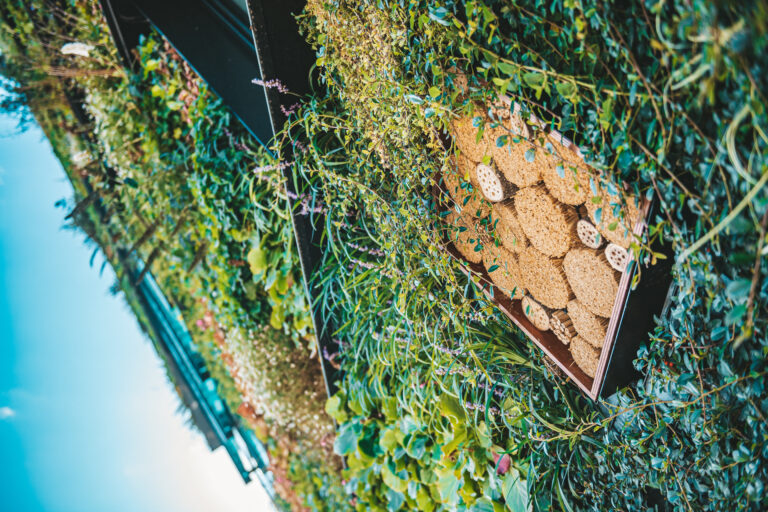
Green facades create valuable habitats in urban areas where green space is often limited. Depending on plant selection, living facades can provide food sources for pollinators, shelter for insects and birds, and ecological stepping stones that connect fragmented green spaces.
For organisations seeking to strengthen biodiversity performance, green facades offer a visible and measurable intervention.
Improving Stormwater Management and Climate Resilience
Extreme rainfall events are becoming more common as a result of climate change. Conventional urban environments often struggle to absorb large volumes of water, placing pressure on drainage systems and increasing the risk of flooding.
Green facade systems can contribute to stormwater management by retaining, slowing or reusing rainwater. This helps reduce runoff, supports urban water management strategies and enhances the resilience of buildings and cities.
As climate adaptation becomes a growing priority for governments and businesses alike, green facades can play an important role in future-proofing the built environment.
Enhancing Air Quality
Vegetation can capture airborne particulate matter and contribute to improved local air quality. While green facades are not a standalone solution to urban pollution, they can positively impact the immediate environment surrounding buildings, particularly in dense urban areas and along busy transport corridors.

Social: Improving Health, Wellbeing and User Experience
The social pillar of ESG focuses on people, health and quality of life. Increasingly, organisations recognise that the built environment has a direct influence on occupant wellbeing.
Positive Effects on Health and Wellbeing
Research consistently shows that exposure to greenery can reduce stress, improve mood and support overall wellbeing.
For offices, residential developments, healthcare facilities and educational environments, green facades help create more pleasant and attractive spaces. They introduce natural elements into dense urban settings and contribute to a stronger connection between people and nature.
As employee wellbeing and user experience become more important factors in real estate decision-making, green facades offer tangible social value.
Creating More Attractive Buildings
Occupants and tenants increasingly seek environments that reflect sustainability, health and quality of life.
Green facades enhance the visual appeal of buildings while demonstrating a commitment to sustainability. They create a distinctive identity and can improve the attractiveness of a property to tenants, visitors and employees alike.
Contributing to Liveable Cities
Buildings do not exist in isolation. They shape the character and quality of the surrounding urban environment.
By introducing greenery into streetscapes and public spaces, green facades contribute to more attractive, liveable and resilient cities. This aligns closely with broader urban sustainability and placemaking strategies adopted by municipalities worldwide.
Governance: Making Sustainability Visible and Accountable
Governance is often associated with policies, transparency and risk management. However, physical sustainability measures also play an important role in demonstrating responsible governance.
Supporting ESG and Sustainability Reporting
The introduction of reporting frameworks such as the Corporate Sustainability Reporting Directive (CSRD) is increasing the demand for measurable sustainability initiatives.
Green facades can support reporting efforts related to biodiversity, climate adaptation, energy efficiency and environmental quality. They provide organisations with a visible example of how sustainability objectives are translated into real-world action.
Reducing Climate-Related Risks
Climate resilience is increasingly recognised as a critical aspect of risk management. Buildings that can better withstand rising temperatures, heavy rainfall and changing environmental conditions are likely to maintain their value and functionality over time.
By improving climate resilience, green facades help organisations mitigate long-term environmental risks within their real estate portfolios.
Contributing to Sustainability Certifications
Green facades can contribute to sustainability certification schemes such as BREEAM, LEED and WELL.
As these certifications become increasingly important to investors, tenants and financial institutions, green facades can strengthen both the sustainability profile and market position of a building.


From Aesthetic Feature to Strategic Asset
The role of green facades is evolving. What was once considered primarily an architectural feature is increasingly recognised as a strategic sustainability investment.
Their ability to simultaneously address climate adaptation, biodiversity enhancement, wellbeing, energy efficiency and urban resilience makes green facades uniquely positioned to contribute across all three ESG pillars.
For organisations seeking practical ways to translate sustainability ambitions into measurable outcomes, green facades offer a solution that combines environmental impact with long-term value creation.
Achieving ESG objectives requires more than ambitious policies. Organisations are increasingly expected to demonstrate measurable action and tangible results.
Green facades provide a unique combination of environmental, social and economic benefits. They support biodiversity, strengthen climate resilience, improve wellbeing and help organisations visibly demonstrate their commitment to sustainability.
As a result, green facades are no longer simply a design feature. They are a strategic investment in future-proof real estate and a meaningful contribution to ESG performance



CONTACT
Would you like to know more about Cloud Garden's green facade solution? We would be delighted to tell you more.